
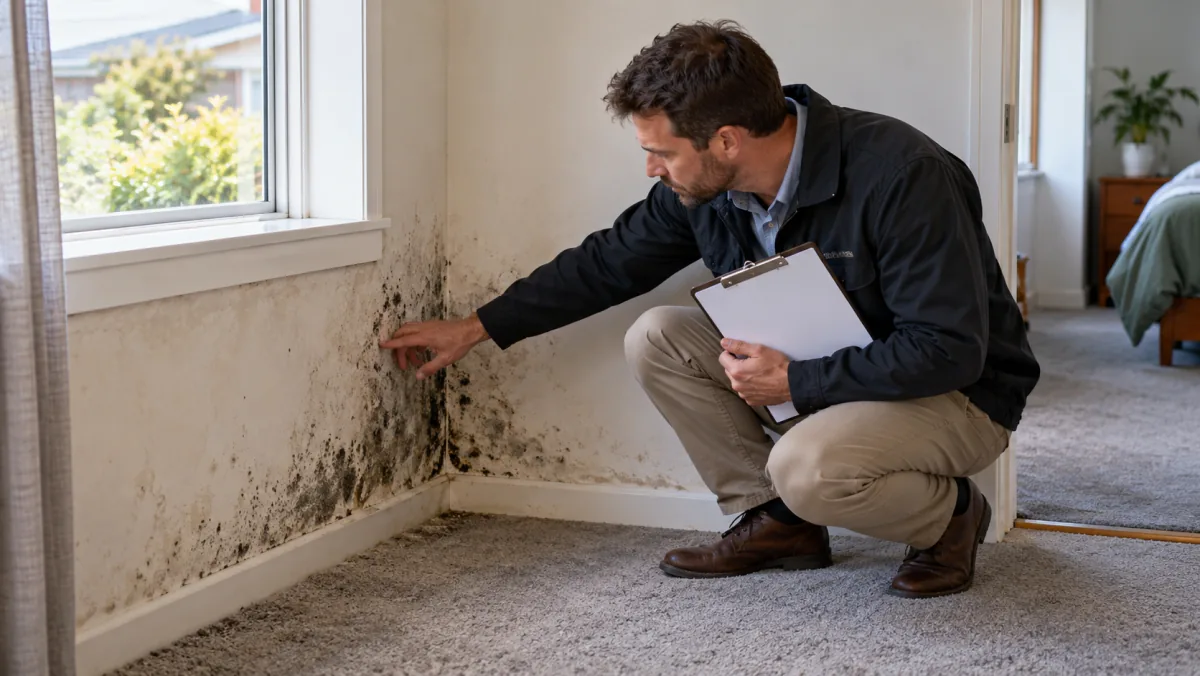
Mould insurance in NZ comes down to one question: how did the damage happen? You have found mould on a ceiling or behind a wardrobe, and you need to know whether your insurer will pay. Most house and contents policies are built for sudden, accidental damage, and insurers usually treat mould as gradual damage. Here is what NZ insurers and dispute schemes say, when a claim can succeed and what to do if it is declined. Cover differs between insurers, so always check your own policy wording.
Why Mould Is Usually Treated as Gradual Damage
Tower and AA Insurance both describe house and contents policies as cover for sudden and accidental damage. Gradual damage is a standard exclusion, and Tower lists mould alongside wear and tear, slow leaks, rot and corrosion as examples.
AA Insurance’s home policy excludes loss involving “rot, mould, mildew, fungi, or smoke damage that has happened gradually”. The Insurance Council of New Zealand lists rot, mildew and other gradual deterioration among common house and contents exclusions.
Finding Mould Suddenly Is Not Sudden Damage
The Insurance & Financial Services Ombudsman (IFSO) Scheme receives many complaints about gradual damage declines. Its guidance is clear: the cause matters, not when you found it. Hidden damage is still gradual if it built up over time.
Mould can also count against a claim. In one Financial Services Complaints Ltd case, black mould on plasterboard was read as a sign the damage built up over time, and another reached the same view about mould on timber frames.
When Mould Insurance in NZ Can Pay Out
The first is a hidden water leak. Some house policies give limited cover for hidden gradual damage from an internal water pipe, tank or waste pipe you could not see. Conditions vary:
- Tower’s benefit does not apply to leaks in a shower base, recess or cubicle
- AA’s benefit excludes leaking gutters and appliances leaking internally
- Repairing the leaking pipe itself is not covered under AA’s or AMP’s benefit
IFSO says these extensions are usually capped at about $2,000 to $3,000. The exact limit is policy-specific and will change over time, so check your current policy wording.
The second is a sudden event. Tower’s water damage guide says damage from a pipe that suddenly bursts is usually covered, including specialist drying and cleaning. The guide to burst pipe water damage covers the next steps. AA notes that sudden damage left unattended can become gradual damage: storm damage to a roof may be covered, but not the rot from the unnoticed leak.
Mould After Floods and Storms
For storm and flood, the Natural Hazards Commission Toka Tū Ake (formerly EQC) covers certain areas of land only. Your home is covered by your private insurance.
Health New Zealand notes that flooding can cause mould to grow, which is why fast flood restoration matters. The guide on why mould appears after flooding explains how to stop it.
Mould in Rental Properties
Tenancy Services says rental homes must be free from mould and dampness before being rented out, and tenants must keep the house well aired and remove mould straight away. For landlords, the Insurance Council lists not complying with the landlord obligations in your policy as a common exclusion, and says these will very likely include regular inspections. See the guide to mould in NZ rentals.
How to Support a Mould Insurance Claim
IFSO says photographs and reports from qualified professionals can help establish whether damage was sudden or gradual. Before you claim:
- Photograph the damage before cleaning anything
- Fix the problem quickly and notify your insurer
- Keep records of maintenance and repairs
- Get a professional inspection that traces where the water came from
A RESTATE moisture and mould inspection (from $595 ex GST) uses thermal imaging and moisture meters to help identify water ingress, and all reports are photographic and ready to issue for insurance.
If your claim is declined, ask for a review through your insurer’s internal complaints process. If you are still unhappy, IFSO says you can ask the IFSO Scheme to investigate for free.
Why Choose RESTATE
- Staff trained in IICRC methods and the Goldmorr mould removal system
- Thermal and borescope cameras, moisture meters and particle counters
- Photographic reports ready to issue to insurers
- Experience working for insurance providers and loss adjusters
- Mould removal and restoration plus reinstatement
- Servicing Auckland and Hamilton
We understand that finding mould is stressful. For typical prices, see our mould removal cost guide.
Frequently Asked Questions
Does house insurance cover black mould in NZ?
It usually does not when the mould grew gradually from wear and tear or a slow leak. A hidden water leak benefit may give limited cover.
Will insurance pay for mould after a burst pipe?
Damage from a pipe that suddenly bursts is usually covered. Damage that develops because the water was left may be treated as gradual, so act fast and tell your insurer.
Does the Natural Hazards Commission cover mould after a flood?
For storm and flood, it covers certain areas of land only. Damage to the home itself is a matter for your private insurer.
Found Mould? Get the Facts Before You Claim
RESTATE provides mould inspection and remediation across Auckland and Hamilton, with photographic reports ready for your insurer. Call 0800 332 664 or contact us for a confidential, no-obligation quote.


