
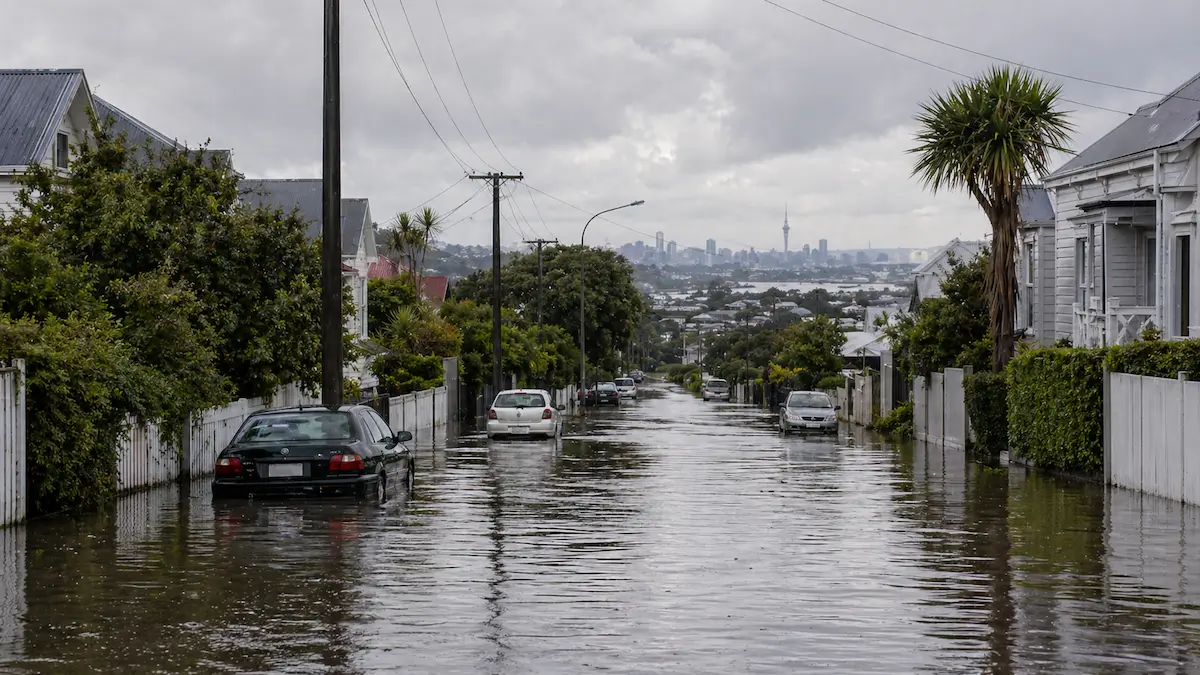
Auckland flooding has shifted from a once-a-decade event to a recurring concern for property owners. What determines whether a flooded home is saved or written off is rarely the flood itself. It is what happens in the first 48 hours after the water recedes.
Call us now for immediate assistance!
Why Auckland floods the way it does
Auckland’s geography works against it during heavy rain. The isthmus sits on more than 50 volcanic cones, and the landscape between them channels runoff through narrow overland flow paths that cut between suburbs and properties. The stormwater network was designed for a different rainfall profile and has a fixed capacity. When that capacity is exceeded, water finds the low ground.
On 27 January 2023, 280mm of rain fell on Albert Park in under 24 hours, making it the wettest day in Auckland’s recorded history. Auckland Airport was among the high-profile sites inundated, and the National Institute of Water and Atmospheric Research classed the event as a 1-in-200-year rainfall. NIWA projections indicate these intense events will become more frequent, not less. Low-lying catchments in West Auckland, Māngere, Onehunga, Wairau Valley, and parts of Mt Roskill are the areas most commonly flooded.
How to check your Auckland flood risk in 5 minutes
Auckland Council publishes a free flood map through its GeoMaps portal. Search for your address, then enable the “Flood Plains” and “Overland Flow Paths” layers. Shaded blue areas show modelled 1% annual probability flood zones. Thin blue lines mark overland flow paths, where surface water travels across your property during heavy rain.
After the 2023 floods, the Council introduced property risk categories under its Making Space for Water programme:
- Category 1. No intolerable risk to life. Normal use continues.
- Category 2P. Intolerable risk, but mitigation is feasible. Options include raising the house, retaining walls, regrading, or altering structures that block overland flow.
- Category 3. Intolerable risk with no feasible mitigation. Voluntary buy-out offers were made.
Your property’s categorisation appears on the Council’s online categorisation map and on the Land Information Memorandum (LIM). The most commonly categorised Auckland flood areas are in West Auckland, Māngere, and parts of the North Shore.
The 48-hour window after floodwater enters your home
Once water enters a building, damage accelerates on a timeline most homeowners underestimate.
- Hour 0 to 24. Carpet, underlay, skirtings, and the bottom 300mm of gib begin absorbing water. Any electrical outlets or appliances within reach of the water become hazardous. Contents sitting on the floor swell and delaminate.
- Hour 24 to 48. Mould spores germinate on any surface that has stayed damp. Gib linings start to crumble. Hardwood floors cup. Moisture trapped in wall cavities and subfloors has no way out without professional extraction.
- Hour 48 to 72. Mould becomes visible. A water event is now a biohazard and an air-quality problem. Repair costs typically double, and materials like solid timber or engineered flooring cross into replace-only territory.
Professional structural drying begins inside this first 48-hour window for a reason. Every hour of delay beyond it compounds the eventual cost.
Save or replace: what’s actually salvageable
Not everything in a flooded home is a write-off. Knowing the difference saves thousands.
- Carpet. Clean water: often salvageable with professional extraction and drying inside 48 hours. Sewage or river water: always replace.
- Underlay. Replace. It holds moisture and cannot be dried effectively in place.
- Gib lining. The bottom 300 to 600mm usually has to come off to dry the wall cavity. Upper sections can be retained.
- Insulation. Replace any batts that were wet. They lose thermal performance and harbour mould.
- Solid timber floors. Often recoverable with controlled drying if action is fast.
- Engineered flooring and laminate. Typically replace. Water causes permanent delamination.
- Contents. Books, photos, soft furnishings, and electronics can often be recovered by a restoration team through freezing or controlled drying, if you act inside 24 hours.
Insurance: three things Auckland homeowners get wrong
Since the Natural Hazards Insurance Act 2023 came into force, flood cover in New Zealand works differently than many property owners expect.
- Your private insurer handles the home; NHC Toka Tū Ake handles the land. For storm and flood, NHC (formerly EQC) only covers residential land damage such as retaining walls, regrading, and driveway scour. The dwelling, contents, and drying costs fall to your private policy. Notify your private insurer first.
- Start mitigation before the loss adjuster arrives. Most policies require you to take reasonable steps to prevent further damage. Calling a professional flood restoration company on day one is expected, not penalised.
- Document before cleanup. Photograph every room, every damaged item, and every waterline before anything is moved. Claims are reduced or declined when pre-cleanup evidence is missing.
NHC recommends lodging land-damage claims within three months, with a maximum of two years. Delays past three months can affect assessment. For a complete walk-through of the claims process, see our guide to flood damage and insurance claims.
When to call a professional Auckland flood restoration team
Call a certified flood restoration company without delay in any of the following situations:
- Water entered from sewage, rivers, or overland flow, not just a leaking appliance
- Water sat in the building for more than 24 hours
- Carpet, subfloor, or wall cavities still feel damp after surface cleanup
- Electrical systems or appliances were submerged
- A musty smell appears within 48 hours of cleanup
RESTATE is IICRC-certified and provides 24/7 emergency flood response across Auckland and Hamilton. Our teams arrive with industrial water extraction, structural drying, and moisture monitoring equipment, and we produce the insurance-ready documentation your insurer needs to process the claim. We understand these situations are stressful. Our job is to take the next steps off your hands.
Frequently Asked Questions
How quickly can RESTATE respond to an Auckland flood emergency?
Our 24/7 emergency team aims to be on site within hours of your call, anywhere across the Auckland region.
Does my insurance cover flood damage?
Your private home and contents policy covers the house, contents, and drying costs. NHC Toka Tū Ake covers residential land damage only for storm and flood events.
Can my carpet be saved after a flood?
Clean-water floods: often yes, with professional extraction inside 48 hours. Sewage or river-water floods: carpet must be replaced on health grounds.
How long does professional flood restoration take?
Structural drying typically runs 3 to 7 days for a single room, and longer for multi-room or subfloor damage, with daily moisture monitoring throughout.
Need help after a flood in Auckland? Contact RESTATE today
If your Auckland property has been affected by flooding, call RESTATE on 0800 332 664 for a confidential discussion and a no-obligation quote. Our 24/7 emergency line is live every day of the year.


